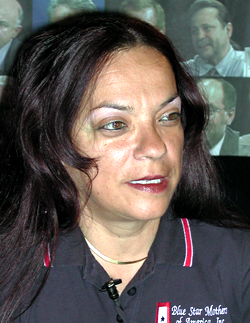
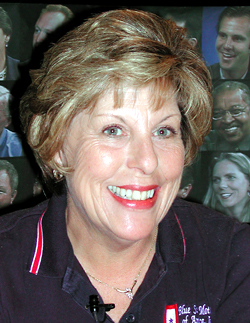
Neff: Yes, he did. He was one of the typical kids who went in for the educational benefits, to see the world, and not really thinking too much at that particular time that there would be a war that would ensue. And of course we were all unbelievably surprised after 9-11, and then it really hit home that, my gosh, he really is in the military and he will be going over there.
Signal: Did he go in right out of high school?
Neff: Yes.
Signal: He probably changed a bit if he went in for the education and experience and ended up going to war. Was it a disappointment, or was it exciting?
Neff: I think it was a little bit of both for him. I think it was tremendously exciting. I think he grew tremendously, as a young man. It was almost a rite of passage. But the military life is a difficult life, especially when you're coming from an environment like the Santa Clarita Valley where you're pretty privileged and all of a sudden you're being told what to do, how to do and when to do it. So I think there was a tremendous adjustment for him, initially.
This was a kid who didn't want to go to college, but certainly didn't want to work in the local fast-food restaurants. So he looked at the military as being, as I said, a rite of passage and to provide direction in his life — which it certainly has.
Signal: Tina, you have a son who is now in Iraq?
Perez: No, my son is recently back also. He is a staff sergeant in the Marine Corps. He is a tank commander. He rolled into Baghdad the first 21 days of the war.
Signal: When did he sign up?
Perez: Thirteen years ago.
Signal: So he's career.
Perez: He's career. Well — he's on reserve right now, and he's also an L.A. police officer. The child was born a warrior — born on Veterans Day.
Signal: Did the Iraq war throw a wrench into his plans?
Perez: No. Like I said, he's a warrior. I don't know so much as that he expected to see something, but he had already been to Desert Storm and Bosnia and Kosovo and Somalia. So this would actually make his fifth tour.
Signal: How many sons and daughters from the Santa Clarita Valley are currently serving in the military?
Perez: Around 865 right now. And at one point last year, more than half of them were overseas.
Signal: How many SCV residents Iraq and Afghanistan these days?
Perez: I'd probably say about 20 percent (are) in Afghanistan and another 35 percent (are) in Iraq.
Signal: Are you counting National Guard and Reserve? Your organization represents everybody?
Perez: Yes. Everybody.
Signal: Have you had an opportunity to visit your kids while they've been in Afghanistan or Iraq?
Perez: No.
Signal: Is that something you're able to do?
Neff: I don't think you are as a private citizen, because it's a war zone. I know that for instance with me, when my son graduated boot camp in Chicago, we did go there and we had an opportunity to see his graduation. But that was the only time from a military aspect that we were able to see him.
Signal: What kind of stories have they told you about what they've seen?
Perez: Well, I think Jason has seen more than his share. At one point I remember him telling me he wasn't quite prepared for the life that he had seen in these other countries, especially Somalia.
The Marines do a certain amount of tour on a ship. So when they were sailing in, he said, about 25 miles into Somalia he said it was gut-wrenching because of the stench and things like that. And he just wasn't ready for that.
Signal: Is he married?
Perez: Yes.
Signal: So he's got a wife who has not seen him much in the last few years?
Perez: No, but she's been there.
Signal: What kind of support does your organization have for wives?
Perez: Blue Star Mothers are the moms (of kids) who are there, but we have lots of wives who are associate members. As associate members, the only thing is, they can't vote. They're there for everything else, though. Their spouses get the packages, and even the husbands, veterans, volunteers — we take volunteers, also — somebody who just wants to be a part of it. We have people who don't have anybody in the military, and they want to do something because they know these troops are doing so much for them.
Signal: What specific kinds of support services do you provide?
Perez: One of the things we do, initially, (it's) for being there for each other. I always tell the moms, "No matter how great of a marriage you have, or what kind of a loving family, there's nothing like sitting in a room with 30 other mothers who are in the same kind of boat as you are."
When someone turns around to you and says, "I know exactly how you feel," you can bet, they really know how you feel. Whether that son or daughter or husband has just gone to boot camp, done the first or fifth tour overseas, or a colonel who has a career, there's a feeling that bonds us.
Some of the things besides initially being there for each other, this year we've sent almost 4,000 packages overseas, and we make sure we get lots of packages out because it's really important to lift their spirits and keep their spirits very high right now.
Signal: What's in the packages?
Perez: Packages contain anything from health and beauty aids, toiletries and, of course, goodies. This year we also started sending out footballs, baseballs, basketballs and gloves.
I received a letter recently that said, of anything that he ever received, he said he was never so glad to receive a football over in another country. He just thought it was great.
Signal: Kris, what has Blue Star Mothers done for you?
Neff: As a mother of a child who was in the military during the time of 9-11, it was a tremendous support group for me. Because I don't think most people realize that even though your military loved one is actually doing a service, as a family you also are in the service. You need to be around other people who understand what you're going through. Because you can only go so much to your friends and your neighbors and talk about how you're feeling, until they start getting pretty sick of you.
One of the nice things is, you know when you go into the room, nobody is going to get sick of you. They're all interested, because we all look at ourselves as being sisters, number one, and so we all look at the children as being all our children. So we're all very much interested in what has happened in the daily life of these kids, and what's going on with us as parents.
I don't know any mother whose child didn't go in after 9-11 who hasn't either put on 20 pounds, lost 20 pounds or who has gotten a good night's sleep. It's pretty hard to communicate that to people who are not involved in some way with a child in the military or a loved one in the military. So it's been a tremendous support to me.
Signal: As the mother of a son or daughter in the military, you deal with the knowledge that every day, your child has an above-average chance of getting seriously wounded or killed. How do you deal with that? Did you have any influence over your son's decision to join the military?
Perez: When your child is in harm's way, you'll pray to the tooth fairy. That's the bottom line.
Neff: I know with me, I was pretty fortunate because my son was never going to be boots-on-the-ground. We were pretty safe in saying that Saddam didn't have a navy. But after the incident of the (USS) Cole, those people who did have kids in the Navy — although it was very remote, there was always that chance that something might happen.
There were incidents and times when I would call Tina or I would talk to another member within the group to get support. Because even though I know he was not directly going to be harmed, you know your kid's out there, and even if that ship docks and they get off at a port, they then can become targets from the various countries that they're in.
So it's difficult. It can be very difficult. I was very fortunate because in the Navy, you can access e-mail. I would stay up till 2 and 3 o'clock at night because of the time difference, and at least I was getting communication (from my) son. A lot of our mothers do not. We have several mothers who, while their sons were in Fallujah during their skirmishes there, they hadn't heard from their kids for three or four weeks. Those mothers were literally hanging on, I think, by a thread.
Signal: Do you think your kids have always told you about all of their life-and-death situations?
Both: No.
Perez: Absolutely not.
Neff: A lot of it is, they just couldn't. They're told that a lot of the information that they have is classified. For instance, my son's ship did have an interesting experience, and I asked my son tonight if I could talk about it (with The Signal), and he said no. There are still things that you will never know that they either participated in, or witnessed.
Signal: Without getting into specific actions — how often has your kid come to you and said, "Hey, mom, I almost got killed today." Do they spare you from that?
Perez: Well, my son — and I know a couple of other mothers have told me this — our sons had said, "Blue Star? Do you know you could have been a Gold Star Mother?" They're thinking of it as getting the gold star in school — as being an honor. And we're like, "No, we don't want to be called Gold Star Mothers."
Signal: You've worked with some Gold Star Mothers here in the Santa Clarita Valley. We're talking about mothers whose sons have been killed.
Perez: We have seven families from Santa Clarita that have now fallen. It's still very raw and very painful, from the very first one during Afghanistan to the most recent one last October.
Signal: Were those parents members of the organization before that happened?
Perez: No, unfortunately. We didn't get to meet those parents until after the incident. But friends of theirs and associates of theirs knew these particular families, and that's how we came into contact with them.
Signal: What can be done to help them?
Perez: Well, there's a program called TAPS — Tragedy Assistance Program for Survivors — and with that, it will get them counseling if they need it. If there are children involved, and financially, if they haven't gotten whatever finances in order, if they need to be, it will help them with that. Through (the) national (organization) and the national Web site, you can find all these various programs that are under TAPS.
Signal: Do you get any support or assistance from the Department of Defense?
Perez: Each chapter is individual now. National (Blue Star Mothers of America) gets the main support, and national gets the clearance for various things.
I recently took the seat as third vice president for (the) national (organization), and that is the Blue-to-Gold liaison for the whole country. And that's very hard.
Signal: Do you travel to Washington?
Perez: I actually am from Washington, so that would be nice. But that's kind of difficult because on a daily basis, you see how many troops we're losing and which states are really getting hit. And you just cry. That could be your son there.
Signal: At The Signal we get casualty notices from the Pentagon several times a day. Do you watch those notices day and night?
Perez: I watch them because I post the casualties onto the national (Blue Star Mothers) Web site. So I watch them pretty closely.
Signal: You're the person The Signal calls when there's a rumor of a local casualty. You seem to know about them long before the Pentagon press release goes out.
Perez: The thing is, as a Blue Star Mother, everything is very confidential. When we ask information, we wouldn't give anything out — any more than I would want to take this third-seat position as third vice president for national if my son was over there right now. Because the last thing I would want to do is see it (posted) before somebody came (to the door). It's bad enough when some stranger shows up at your door. So, we wouldn't tell anybody, anyway. It's up to the families.
Neff: I think we can corroborate that we have lost somebody, but I think we're unable to give out information.
Signal: What kind of communication do you have with kids who are stationed over there? Do kids from Santa Clarita communicate with each other once they're in Iraq or Afghanistan?
Perez: Actually, yes. We have a couple of kids who just came back last year and they just found out that both of their mothers were in the same organization.
Now, we have two moms whose sons are both stationed in New York and ready to deploy to Iraq in September. One of them had just graduated boot camp, so she was a very worried mom. And the other mom, who's kind of a vet like myself — well, my son's a sergeant; (he has) been there a while — so what they did was exchange phone numbers and called their sons and they got to meet each other, which was kind of nice.
I would imagine the hardest part of that was trying to look out for each other, knowing that they come from the same hometown.
Signal: You have a banner that was signed by — whom? What is that about?
Perez: That's the Blue Star banner, and that is the banner to show active military. Anybody. They come in a smaller size, a window size, and they have a cord on them so you can hang them in your window. When you display that, it shows that somebody in that family is active military.
That particular banner went to Iraq and was signed by one of the husband's platoons that was there. And as our sons and daughters have been coming back, we've been having them sign it. It's getting pretty full. We'll probably need another if we ever find all 865 families from Santa Clarita.
Signal: Do the people in your organization get political?
Neff: It has gotten political at times. Our mission statement is to be, obviously, nondenominational and nonpartisan, and yes, we have mothers who don't support the war and we have mothers who do. But that's not our focus. Our focus really is the kids, and supporting the kids. We don't want to turn it into a political organization in any way. That's not what we're about.
Signal: We've had a couple of anti-war protests in Santa Clarita. Does that register with you? What is your reaction?
Perez: It registers. But let me tell you that Santa Clarita is very, very supportive of the troops. Like on (May 30) we had a Memorial Day ceremony with the opening of the new Veterans (Historical) Plaza (in Newhall). We also do something called a Military Round-Up in front of one of the local department stores. People are very supportive and very generous.
You don't have to support the war to support the troops, and that's the main focus. I would say, everyone who've I've run into in Santa Clarita supports the troops. I have not met somebody who is derogatory toward the troops. They might not like the war — none of us like war — but they do support the troops.
Signal: The latest Gallup Poll showed that 57 percent of Americans polled now believe, in retrospect, that it wasn't worthwhile to go to war in Iraq. You're not too far removed from the Vietnam era; you saw how returning troops were treated when the Vietnam War dragged on and on. With what's happening in the media right now, do you fear we could be looking at another Vietnam situation when these troops return home from Iraq?
Perez: No. That won't happen because we are the children of Vietnam. It was our husbands and our brothers and our fathers who were in Vietnam, and we saw what happened.
I saw firsthand. I had four brothers in the military all at one time, and a sister in the Navy. I saw what happened, and it's not going to happen.
One thing about the Blue Star Mothers — especially this generation of Blue Star Mothers — we saw what happened to Vietnam (veterans). That's not going to happen to our children.
Signal: What do the Blue Star Mothers do for the troops when they come home?
Perez: We try to make it to the homecomings, just to greet and give a hug to anybody. Sometimes we'll see people, especially the troops, we'll see moms running around or something, giving them a hug. The same thing we're going to do this weekend (June 4), as a matter of fact, for deployment. Sometimes you'll see guys sitting on their duffel bags while other troops are with their families saying good-bye and things like that. The last few deployments that I've been to, I'll just walk up to a troop and just give them a hug. You hug every troop like they're your own.
Signal: Kris, what is your son doing now that he's out?
Neff: We're supporting the fact that he wanted to go back to school full-time, and he is doing that. We're very pleased.
Prior to his going into the military, this was a kid who left the peanut butter beneath his bed with a knife stuck in it and was not very directed as to what he wanted to do with his life. Since coming out, he knows what he wants to do, and right now he is hotly pursuing every class that he can get hold of.
One of the things, to get back to your question, what are we doing to support those who are getting out of the military — we would like to think that we are not a stagnant organization (or) that we are only supporting (the troops) through our packages. We are always constantly looking for ways to support those people who also come home.
There are currently a couple of ideas on the table that we're pretty excited about, but we haven't really discussed them with our general membership — but we're hoping maybe to offer some grants at (College of the Canyons) for those kids who do go back to school and need extra money for books and things. And it's something that we're going to be exploring in further detail.
Signal: The national organization started after World War II. You started the SCV chapter when?
Perez: March of 2003.
Signal: Coinciding with the start of the war in Iraq. Was there not a need for the organization here before that?
Perez: Actually, I was watching the news the first 21 days of the war, and my son's a tank commander. I saw the tank roll off the bridge and instantly became hysterical, to say the least.
I had called the recruiters. I called City Hall. I called the chamber (of commerce). I was looking for a support group. I had belonged to a Blue Star Mothers chapter back East, and there wasn't any (here). And one day when I was doing one of my 12 packages during the month, the paper somehow got hold of it ... and my phone started ringing, and these mothers all started calling (and) saying, "My son's over there, too. What can we do?"
So one day we had, like, five women around a table, and we decided we wanted to do something — we don't want to just sit around and feel sorry for ourselves. Let's do something where we can at least feel good about ourselves. And that's when we started.
We decided that Memorial Day, we got the (Santa Clarita City) Council's cooperation, and we started putting blue stars up on the trees in front of City Hall. Moms started coming out all over the place, saying, "Hey, I have somebody in the military." And then — today there's a chapter here. Since then, we were the only bona fide chapter in Southern California up until last year, when there was a spin-off in Redondo Beach and one in Anaheim. And just recently, earlier this year, Antelope Valley had a spin-off from us, too.
There's a great need for it, but people don't know how to get started.
Signal: How do people get in touch with you?
Perez: They can go onto our Web site, which is www.bluestarmothersofscv.org. They can also go to (Santa Clarita) City Hall. There are applications right in the lobby there. They'll also get to see the military (photographs) of all our gorgeous troops.
One of the reasons we support both military and the veterans is because today's military are tomorrow's veterans.
Neff: I think it's important for other people in the community to know that there is a group of people out there who understand what they're going through, that will help them to go through it and answer any questions that they have. I would hope that they would seriously consider joining our group.
See this interview in its entirety today at 8:30 a.m., and watch for another "Newsmaker of the Week" on Wednesday at 9:30 p.m. on SCVTV Channel 20, available to Comcast and Time Warner Cable subscribers throughout the Santa Clarita Valley.