History of Newhall School.
|
The town of Newhall was established in the summer of 1876 as a little flag stop along the brand-new Los Angeles-to-San Francisco line of the Southern Pacific Railroad. Named for local land owner Henry Mayo Newhall, the town originally sat near the modern-day intersection of Magic Mountain Parkway and Bouquet Canyon/Railroad Avenue. On May 10, 1877[1], the Newhall School District came into existence on the petition of Judge John F. Powell and 47 others. We don't know where classes were held, but the teacher in 1877 was Kate A. Caystile.[2] 1877 was a serious drought year, so in January 1878, the whole town picked up and moved two miles south — train depot and all — to be closer to indigenous water sources in Railroad Canyon (Pine Street area). As an aside, the Saugus train station was erected a decade later roughly where the Newhall depot originally stood. Like most of the small frontier towns that dotted the dusty expanses of the Old West, early downtown Newhall was little more than a cluster of saloons, livery stables and general stores, with a large Victorian hotel to serve passing travelers. Fueled in part by the 1876 discovery of vast oil resources in the area, families began to move into the regions surrounding Newhall. In 1878, fifty-three school-age children lived in or near Newhall. Teacher Kate Caystile tutored six of them — which was typically one fewer than the number officially needed to sustain a school district. Perhaps nobody noticed. For the 1878-1879 school year, Caystile held class in a corner of Addi Lyon's bunkhouse on the Sanford Lyon Ranch, where wooden boards from the beds were retooled into desks. Used just the one year, the makeshift "school" was located near old Highway 99, about halfway between downtown Newhall and the Pico Canyon oil town of Mentryville — roughly where the Valencia Marketplace stands today. In 1879, the town fathers decided to construct a self-standing schoolhouse at the northeast corner of 9th and Walnut Streets, two blocks back from Newhall's Main Street (aka Railroad Avenue, not today's "Main Street"). This first "official" school was a two-story wooden building with a belfry centered above the doorway. Thirty-nine year old Judge Powell, who would serve for nearly four decades as justice of the Soledad Judicial District, financed the staggering $3,500 construction cost. Even with the new structure, no more than 13 children attended school at any one time. Daily attendance averaged just seven children. More children probably showed up for the sandlot baseball games in the open fields surrounding the school than showed up for their lessons. Nonetheless, the school was busy, even on weekends. Sunday school classes were held on the second floor during the 1880s, as the local First Presbyterian Church didn't come along until 1891. Catholic services were also held in the schoolhouse at least as early as 1883. The Newhall School District was governed by a 3-person board of trustees. Under state law at the time, school districts had 3-member boards unless they were "union" school districts — meaning the union, or merger, of two or more districts — in which case they had a 5-member board. Newhall's early school boards were composed primarily of local businessmen such as George Campton, the town's first general merchant, who was re-elected several times. Fire would prove the nemesis of the Newhall School District in the early years. It struck for the first time in 1890, burning the original Newhall School to the ground. A residence at 719 Spruce Street (now known as Main Street) was used temporarily until a new schoolhouse could be erected near the site of the last, on a large lot at the northeast corner of 9th and Walnut streets (the latter was originally called Fir Street). This time it was Henry Clay Needham, a local entrepreneur who would later seek the United States presidency as a Prohibition Party candidate, who provided most of the funding.
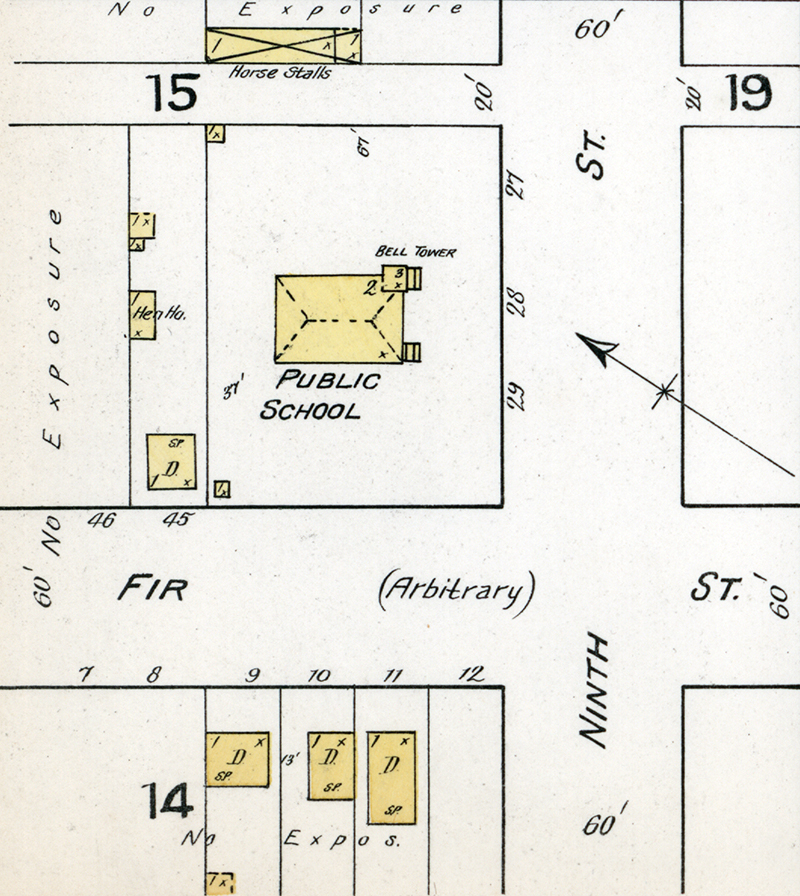
Newhall School housed 60 first-through-ninth graders during the 1890s. In 1892 a second classroom was added to the two-story structure, which sported a bell tower at its right front corner. Children who wished to pursue their studies beyond the ninth grade could do so after 1896, when San Fernando High School was built. After 1899, ninth graders joined their underclassmen at San Fernando High, as the ninth grade was discontinued in Newhall. Local history books tell us the second Newhall schoolhouse suffered the same fate as the first in 1914, burning to the ground — but this is by no means a certainty. For one thing, we've never encountered a contemporary news report about any fire, which is unusual considering the L.A. papers covered the Newhall area quite extensively at the time. (The Signal came along in 1919.) For another thing, the first comprehensive local history, compiled in 1940 by Newhall librarian Mary F. Brunner and others, tells an entirely different story. Brunner says the property was not large enough to accommodate a necessary expansion, so an alternative site was found — in 1911, not 1914. Neither explanation is particulary satisfying. We know from photographs and from a site map (inset) that the property was plenty big to accommodate an expansion. And if the school building burned down, why was it not rebuilt on the same site, as was done in 1890? Whatever the reason, and whether in 1911 or 1914, the third two-story Newhall School was erected on 10th Street, aka the Pico Road (called Lyons Avenue today), just east of Kansas Street. This schoolhouse was indeed larger: a three-room building with a double-wide front door that opened out onto the street. By the end of World War I, older children no longer had to travel by horseback or bicycle to San Fernando. Now they could ride in a converted automobile that Newhall merchant S.D. Dill used as a school bus until 1932, when he purchased a new bus. The school site on 10th Street (Lyons) didn't lend itself to expansion (for real this time), and when a permanent home with "growing room" was secured at the corner of Eleventh and Walnut Streets in 1928, the former schoolhouse was split in half and converted into private homes. The new Eleventh Street site became a community gathering place, particularly on the Fourth of July, much as the earliest Newhall school sites had been. The original "Newhall Park" was not the current Newhall Park, but rather a large open area adjoining the school to the north. It was the venue for town get-togethers on Independence Day, when people came from miles around to participate in greased pole and greased pig contests; played baseball until dusk; listened to patriotic speeches; collected for old-timers reunions; and posed for panoramic post-parade photographs. But it was not to last. Eventually the park space gave way to housing. Fire ravaged Newhall School for the second? third? time in fifty years on Valentines Day, 1939. All but a few rooms in the north wing were destroyed. This time, however, the school would not be relocated. Construction began immediately to replace the burned-out buildings. The school reopened on May 10, 1940. The nation was just emerging from the Great Depression, and with new federal programs at its disposal that had not existed prior to the New Deal, the school board applied to the Work Projects Administration (WPA) to build a school auditorium. WPA workers finished the job in September 1941. The auditorium held 460 chairs on sloped flooring, an orchestra pit, and an upstairs projection room with a film vault. Again Newhall School would become a community gathering place, as patrons assembled in the auditorium for movies, plays and special events. By this time Newhall School was again housing the ninth grade, but not for much longer. On January 13, 1945, the California State Board of Education approved the petitions of five Santa Clarita Valley school districts — Newhall, Saugus, Castaic, Mint Canyon and Sulphur Springs — to form the "Santa Clarita Union High School District." Two weeks later, on January 29th, local residents voted 1,184-7 (yes, seven) to create Santa Clarita Union High School District. On March 9 they elected its first five-member board — five, because it was a "union" district — and on June 2, they voted 432-2 to pass a $300,000 bond measure to build the valley's first high school on a 27-acre parcel on Newhall Avenue, just down the street from Newhall School. The name "Santa Clarita," or "Little St. Clare," had been suggested for the new school and district by town historian A.B. Perkins. It was a diminutive form of "Santa Clara," the name Portolá diarist Father Juan Crespí had given the valley's river in 1769. However, the name was so unpopular that in the spring of 1946 it was changed to honor the young district's chief benefactor, the aging silent film cowboy and Newhall resident William S. Hart. The first Hart District governing board was composed of school board members from each of the elementary districts. Tom Frew III and S.S. Donaldson represented the Newhall district. Donaldson was a sitting Newhall school board member, while Frew had already retired from a lengthy tenure on the Newhall board which included several years as president. Newhall School's ninth grade class of 1945-46 became the first Hart High School students in 1946-47 and went on to become Hart's first graduating class, the famous "'49ers." Newhall's seventh and eighth grades moved over in 1948 as Hart became a junior and senior high school, which it remained until the 1961 opening of nearby Placerita Junior High. In the ensuing years the area grew as never before. Additions were made to Newhall School in 1946, 1950, 1954 and 1958. Peachland Avenue became the site of the elementary district's second campus in 1959, followed by Wiley Canyon School in 1966. When the New Town of Valencia moved off of the drawing board and into reality in the late 1960s, additional schools were needed. Old Orchard opened in the 1969-70 school year, followed by Meadows in 1976, Valencia Valley in 1988 and Stevenson Ranch in 1995. Much has changed since the days when the fledgling Newhall School District had to struggle to get the requisite seven children together for classes. In 1997-98, the seven campuses of the Newhall School District will serve a student population of almost 6,000 kindergarten-through-sixth graders. The schools consistently win awards for academic excellence, ranking among the top ten percent of all public schools in California.
1. In addition to Brunner's 1940 history of the Newhall School District, which was based on school district records, whenever Los Angeles County published a bond-sale notice for a school district in the mid-20th Century, it included the date of the school district's founding. The date the county used for Newhall was May 10, 1877. (See, e.g., Legal Notice, The Signal, February 14, 1941.) 2. Brunner's 1940 history of the Newhall School District.
©1997/2019 Old Town Newhall USA / SCVHistory.com • All rights reserved. |