|
|

Glossary of Archaic Terms, Etc.
Californio
The standard definition of "Californio" is a person of Spanish descent who was born in (Alta) California. The term often carried class overtones and sometimes applied to landed gentry and aristocrats of Castillian Spanish ancestry regardless of birthplace (e.g., Ygnacio del Valle, who was born in Jalisco, Mexico). Many Californios were of mixed ancestry (Spanish, Mexican, Indian, other) but identified most closely with their Spanish heritage by speaking Spanish, practicing Catholicism and participating in cultural activities of Spanish origin such as fandangoes. (For example, San Diego-born Gen. Andres Pico, a prototypical Californio, was of Spanish, Indian and African ancestry.)
The term "American" denoted persons, usually Anglo, from the United States, who began to arrive in Alta California in the 1830s. Like French, English and Russian immigrants, Americans were considered foreigners during the Mexican period. Even after statehood in 1850, "American" was used to describe persons from Eastern states and territories, or their California-born descendants.
A "Mexican" was a person who came to Alta California from Mexico "proper" — often but not exclusively from Sonora, ergo Sonoratown (the Mexican barrio in 1850s Los Angeles) — and such persons continued to be called "Mexicans" after statehood regardless of citizenship. The term often carried class overtones opposite from those of "Californio."
"Indians" were persons whose ancestors already lived in (Alta) California prior to European contact in 1769 and who were either brought into the Spanish mission system or fled from it.
Upon the conclusion of the war of 1846-48, Californios and Americans forged social, political and business alliances, and members of both castes held elective office upon statehood. Mexicans and Indians did not. In fact, Indians were denied full U.S. citizenship until June 2, 1924.
Marriage Bann, Blessing
No, those aren't opposites. A "bann" is an announcement of an intended marriage. Historically, some religions "published" the announcement of a wedding before it could occur. In the Spanish Catholic mission system in California (Alta and Baja), it's likely the priest would announce the planned marriage during (apparently often three) consecutive services. It's akin to an extended period of "speak now or forever hold your peace."
There were two basic types of wedding ceremonies within the mission system: a casamiento (marriage) and a velacion or velado (blessing). In a casamiento, the couple "gives their hands" in the presence of a priest and two witnesses, and they are married in the eyes of God and man. A velado is a solemn nuptial blessing of the couple during mass.
Ethnicity (Spanish Mission System)
Baptism, marriage, death and other records in the Spanish mission system in California (Alta and Baja) categorized people by "ethnicity," which isn't exactly the same way the term is used today. Common descriptors were "Californio," meaning persons of Spanish (European) ancestry (see above); "Razon," short for gente de razon, usually referring to California Indians who've been baptized into Catholicism and who are living within the mission system, whether at a mission or at a rancheria, i.e., "Mission Indians;" and "Indio," meaning an unbaptized Indian.
The terms "neofitos" (baptized Catholic) and "gentil" (non-Catholic) were often used to denote religious status.
What/Where/Why 'Grapevine'?
While the name is commonly used to denote a longer stretch of Interstate 5, the "Grapevine" is actually just the 6.5-mile segment of highway that runs from Fort Tejon northward to the bottom of the grade in the San Joaquin Valley. In 1772, Spanish military officer Pedro Fages, then-governor of California, named the north side "Cañada de Las Uvas," or Canyon of the Grapes, for the wild cimarron grapes that once grew there. Contrary to popular belief, the name "Grapevine" is unrelated to the serpentine course of the 1915 Ridge Route highway in the same location.
What is Placer Mining?
Placer mining refers to the extraction of gold from a placer deposit.
Gold occurs naturally in two basic forms: in a lode (the primary source); or in a placer deposit (a secondary source).
In a lode, hydrothermal forces have pushed the gold up into solid rock from deep within the earth. Hard-rock mining techniques are used crush the rock and extract the gold.
If a lode deteriorates (erodes), gold particles are freed. The source of the erosion — rain, a river, etc. — carries the gold particles until they settle, usually in quiet part a sandy riverbed. This secondary deposit, the place where the gold accumulates, is called a "placer."
Placer mining involves the use of a pan or sluice box to separate the gold from the lighter sand and gravel around it.
What is a Real Photo Postcard?
A real photo postcard, or "RPPC" in the conventional lingo, is an actual photographic print (i.e., a photo), as opposed to a printed, mass-produced postcard.
Way back when, photographers had the option to have their photographs produced on preprinted postcard stock. Thus an RPPC is an original print that has been produced photographically in a darkroom. In contrast, mass-produced picture postcards are generated lithographically on a printing press. As a result, RPPCs are generally much rarer than printed postcards. (Photographers occasionally produced more than one original print — an "original print" being one that was produced from a negative in the manner described above. Multiple RPPCs of certain images of Newhall in 1909, for instance, are known.)
RPPCs have much greater detail than printed postcards, and the difference is easily distinguished under a magnifying glass. If you see a dot pattern in a black and white picture postcard (or a peculiar lithographic pattern in a color postcard), it's not an RPPC.
Color postcards, even "linen" postcards and those which appear to be hand-tinted, are almost never RPPCs.
What is a Key/Keybook Photo?
Definition from Heritage Auctions:
During the Golden Age of Hollywood and beyond, still photos were a vital part of the Hollywood publicity machine. Some stills were distributed to various media outlets to promote stars and build interest in upcoming films, while others were intended for studio use only, often serving as a continuity map for wardrobe, sets, and storyline. Stills in this latter category, produced and collected for use by the studio and those working on a particular film, were called key, or keybook, stills, and were never intended to be released or viewed by the public. Produced in far lesser quantities than those stills intended for public distribution, they are considered today some of the most desirable stills associated with a particular star or picture, as they are extremely rare and hard to find.
Often, but not always, they are 2-, 3- or 4-hole punched for insertion into a key book.
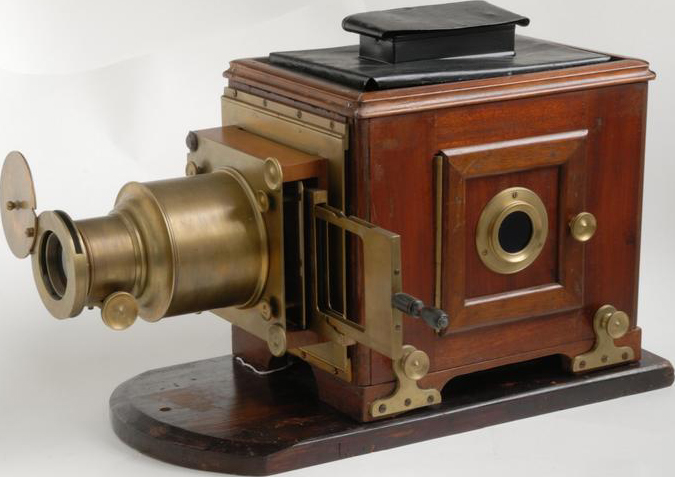
What is a Magic Lantern/Slide?
A magic lantern is quite simply an early slide projector. Invented in the 1600s and initially illuminated by candle light, it projected a hand-painted image onto a wall or screen.
In the silent film period, magic lanterns used a big electric bulb (typically 500 watts) to project photographic glass slides showing coming attractions. Provided by the film distributor, the slides were 3¼x4 inches and colorized, with a blank space usually at the bottom so the movie house could hand-write in the days or the dates the film would be shown.
Other applications included slide shows, which were popular events when an explorer or traveler came to town. The images were often the general public's only exposure to exotic places.
Slides were also used for educational purposes in schools, especially those manufactured by the Keystone View Co. from 1892-1963.
What is an Arcade/Exhibit Card?
Arcade cards, aka exhibit cards, were one-sided, 3⅜x5⅜-inch cards printed on heavy, yellowish stock and produced by the Exhibit Supply Co. (ESCO) of Chicago from 1921 to 1980. They were popular collector items, just like tobacco cards, which started earlier, and bubble gum cards, which started later. Themes varied from baseball and other sports to movie stars.
ESCO supplied machines for penny arcades — fortune tellers, test your strength or your love, etc. The company's arcade cards sold for 1 cent (2 cents or more in later years) from vending machines made by ESCO. The vending machines varied in size and style, but the cards didn't; they were always 3⅜x5⅜ inches and almost always monotone. They varied only in color and printing from year to year, and collectors can generally tell what year a card was manufactured from its color and font style and placement of text, if any. Production tapered off after 1971; ESCO produced baseball card sets in 1977 and 1980.
ESCO's rival in both the card business in particular and the penny arcade business in general in the 1940s and 1950s was the International Mutoscope Co. Mutoscope cards were slightly smaller. Sources indicate Mutoscope was eventually absorbed into ESCO.
'Santa Ana' Winds?
The term "Santa Ana winds" seems to be a mid-20th-century bastardization of the original term, "Santana winds," or "devil winds" — "Santana" being a Spanish variant of "Satan." Most sources attribute its folk etymology (the alteration of an unfamiliar word over time to resemble a more familiar word) to early television news commentators.
These hot, drying winds don't originate in the city of Santa Ana; rather, they occur when the air coming off the desert is squeezed through the mountain passes and is forced in a southeasterly direction toward the ocean. (Their opposite, the colder onshore flow, travels northwesterly from the ocean toward the desert.)
The following explanation is excerpted from the city of Los Angeles Fire Department's official report on the Bel Air Brush Fire of Nov. 6, 1961 (at lafire.com):
The most significant weather factor contributing to the demonic fury of the conflagration which assailed Bel Air and Brentwood was the prevailing wind condition. Called variously "Santanas," "Santa Anas" or "Devil Winds," they are a phenomenon which occurs in the coastal regions of Southern California during the late fall and winter months. These winds are generally characterized by conditions of drastically low humidifies and high velocities. Effects on atmospheric temperatures are dependent upon the state of variable forces which affect the winds during their formation. Usually there is a marked temperature rise, especially if the Santana conditions persist over a prolonged period.
The initial formation of the Santana winds occurs as a large, cold air mass from the polar regions of the Pacific moves south into the arid interior areas of Utah, Nevada and eastern California. From these barren wastes, the mass travels south and south-westward, influenced by atmospheric pressure differentials between the interior areas and the reaches of the Pacific Ocean. As the currents flow across the arid deserts and into the passes and canyons of the coastal mountains, they are dried and heated. Under conditions of moderate barometric gradients, the winds funnel through the passes; compressing to increase velocities to gale force. If pressure gradients are excessive, the winds will pour directly over the mountains to strike the Los Angeles Basin a few miles south of the foothills. In such instances, great clouds of dust are raised to tinge the skies. Temperatures are raised by compressional heating as the wind currents descend to progressively lower levels.
As these winds whip through the mountains and across the surface of the coastal lowlands, every wisp of vegetation and every stick of wood is drained of any vestige of moisture. Relative humidity readings fall ominously and have been recorded as low as three and four percent.
The arrival of these winds on the coastal plain is presaged by clearing skies, starry nights, and a drop in temperatures. As the Santana begins to blow, temperatures rise and the relative humidity plummets rapidly. It is not unusual for Santana conditions to last for a week. With each passing hour, the fire danger increases.
Stage/Celerity Wagon vs. Stagecoach: What's the Difference?
Celerity means "swiftness of speed." The word "celerity" is like calling a class of cars SUVs. The term "celerity wagon" is sometimes used instead of "stage wagon."
Each company made its own variation of the celerity wagon. It was about half the weight of a stagecoach and was designed for rough conditions where the trail was not as well developed, in sand, and for traversing steep inclines. Its wheels were often a smaller diameter than those of stagecoaches to give it a lower center of gravity and make it difficult to tip over. The wheels were often thicker to better support the wagon in soft earth.
These thicker wheels threw mud onto the passengers during wet conditions, so these stages were also called "mud wagons."
A particular type of stage wagon, made from John Butterfield's design instructions, was used by Butterfield's Overland Mail Co. exclusively on 70 percent of the Southern Trail. His stage wagons were made in either Albany or Troy, N.Y.
— Gerald Ahnert 2014
What is Vulcanizing?
Vulcanization is a technique for hardening rubber by heating and chemically combining it with sulfur. The process also makes the rubber stronger and more elastic. If the sulfur content is increased to as much as 30 percent, the product is the inelastic solid known as ebonite. More expensive alternatives to sulfur, such as selenium and tellurium, are used to vulcanize rubber for specialized products such as vehicle tires. The process was discovered accidentally by U.S. inventor Charles Goodyear in 1839 and patented in 1844. Accelerators can be added to speed the vulcanization process, which takes from a few minutes for small objects to an hour or more for vehicle tires. Molded objects are often shaped and vulcanized simultaneously in heated molds; other objects may be vulcanized in hot water, hot air or steam.
The first pneumatic (inflatable) rubber tire was patented by R.W. Thomson in 1845; John Boyd Dunlop of Belfast independently reinvented pneumatic tires for use with bicycles in 1888-89. Information: Helicon Publishing Ltd.
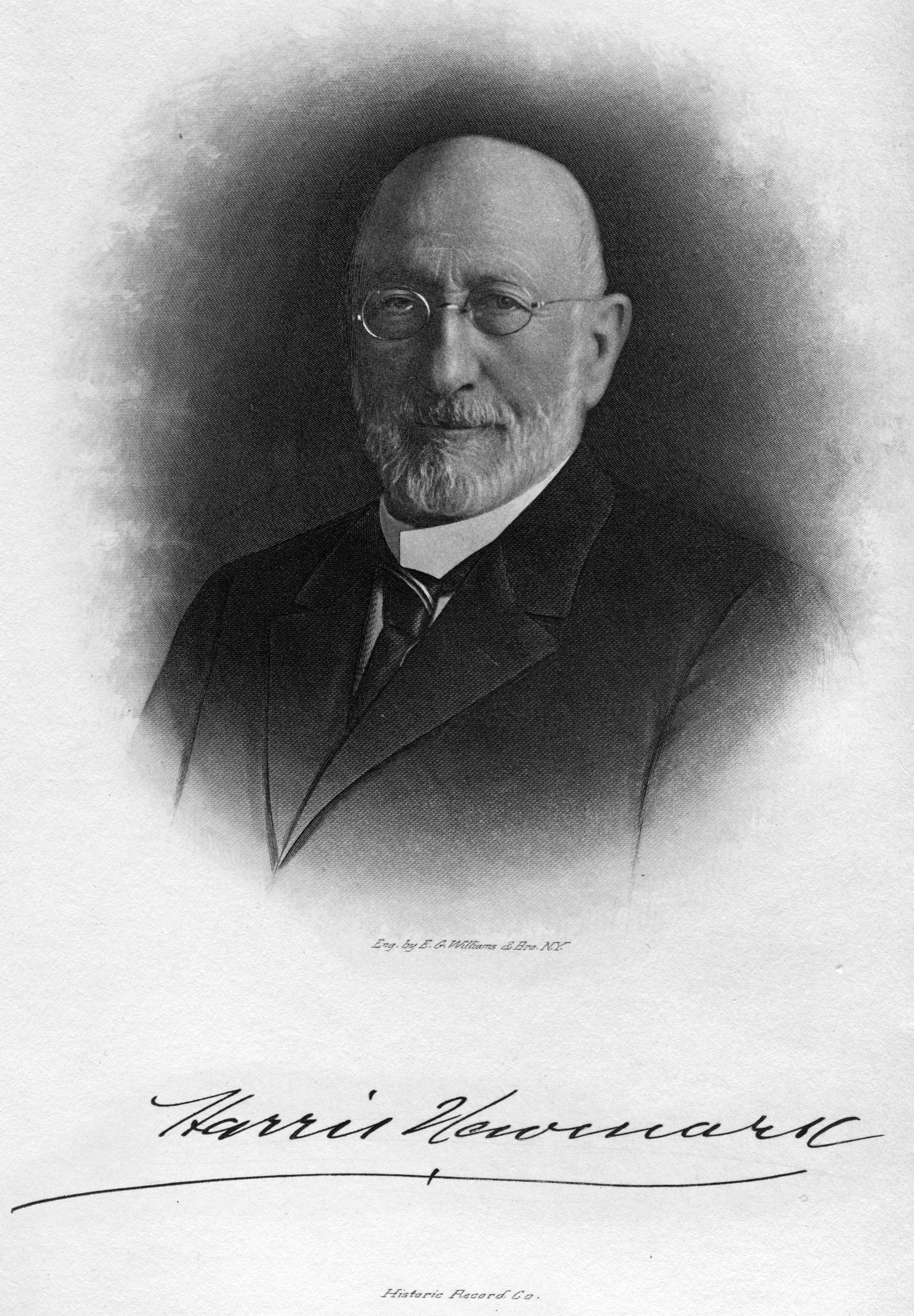
Harris Newmark, "Sixty Years in Southern California, 1853-1913"
When the Prussian-born Jewish merchant Harris Newmark arrived in Los Angeles at age 19 on Oct. 21, 1853, after living in Sweden, land around the downtown pueblo was selling for $1 an acre and the population numbered less than 8,000. Roughly half were Indians, who were denied U.S. citizenship, in contravention to the five-year-old Treaty of Guadalupe Hidalgo. That's not to say they didn't vote. Newmark tells us leaders of both political parties in the tightly Democratic-controlled pueblo were guilty of rounding them up, herding them into horse corrals, plying them with liquor and bringing them to the polls the next morning. There was no such thing as checking for
voter ID. Newmark knew the comings and goings and achievements and failures of every leading citizen, and over the next 60 years, he watched Los Angeles grow from a dusty, rough-and-tumble pueblo — where, on average, somebody was murdered every day — into a vibrant metropolis of tall buildings, land barons and water czars (initially called zanjeros).
But Newmark did more than watch. He was an active participant, joining his brother's grocery and dry goods mercantile business upon arrival and amassing sufficient fortune over the years to purchase the Repetto Ranch in East Los Angeles, ultimately subdividing it into what would become Montebello. A prominent Mason, he helped found the Los Angeles Public Library and Chamber of Commerce, and the Jewish Orphans Home, as well as the Southwest Museum (now part of the Autry National Center).
He wrote his memoirs but didn't live quite long enough to see his sons publish them in 1916 as "Sixty Years in Southern California, 1853-1913." His reminiscences surpassed those of his contemporary Horace Bell in importance and, no doubt, in accuracy. In the foreword, his friend and fellow Los Angeles chronicler Charles F. Lummis characterizes Newmark's work as "the Pepys's Diary of Los Angeles and its tributary domain," for, like the 17th-century Englishman, Newmark presents us with a primary source as he soberly records an eyewitness chronology of transformative times — albeit largely from memory, from 1913-16.
"No one else has ever set down so many of the very things that the final historian of Los Angeles will search for," Lummis writes, "a hundred years after all our oratories and 'literary efforts' have been well forgotten."
For the Santa Clarita Valley scholar, Newmark's "Sixty Years" is an indispensible reference that gives us, like no other, in one place, a biographical accounting of the life and times of figures who loom large in our history, from Del Valle and Pico to Jenkins and the brothers Lyon to Lang and Newmark's own onetime zanjero contractor, Mulholland.
Newmark knew he was watching history unfold and purposefully set out "not with the ambitious hope of enriching literature in any respect, but not without confidence that I have provided some new material for the local historian — perhaps of the future — and that there may be a goodly number of people sufficiently interested to read and enjoy the story." In this he succeeded.
The Land of Sunshine / Out West magazine
Distributed nationally, "The Land of Sunshine: The Magazine of California and the West" was founded as a monthly in June 1894 by F.A. Pattee as a vehicle for promoting the attrations of Southern California. In December 1894, Charles Dwight Willard, secretary of the L.A. Chamber of Commerce, recruited journalist and book author Charles F. Lummis to serve as editor.
The initial size was 9x12 inches, two colums to the page. In June 1895 it contracted to 6x9 inches but expanded its page count. F.A. Pattee became business manager of a new publishing firm, The Land of Sunshine Publishing Co., whose board members included W.C. Patterson, president; Lummis, vice president; Pattee, secretary; Charles Cassat Davis, attorney; and Cyrus M. Davis.
Lummis had gained national attention in 1884 when he "tramp[ed] across the continent," walking 3,500 miles from Cincinnati to take a writing job at the Los Angeles Times. Along the way he learned the errors of his Eastern preconceptions of Indians. Lummis filled "The Land of Sunshine" with stories of Old California, Arizona and New Mexico and used his monthly "Lion's Den" column to champion Indian rights. In time he bought out Willard's interest in the magazine and grew it with funding from William Randolph Hearst's mother, Phoebe.
In 1900 the magazine listed a staff of David Starr Jordan (president of Stanford University and Lummis' close friend) and literary standouts Joaquin Miller and Ina Coolbirth. Lummis friends John Muir and Jack London wrote occasionally. Others listed as staffers were Theodore H. Hittell, Mary Hallock Foote, Margaret Collier Graham, Charles Warren Stoddard, Grace Ellery Channing, John Vance Cheney, William Keith, Dr. Washington Matthews, Dr. Elliott Coues, Geo. Parker Winship, Frederick Webb Hodge, Charles F. Holder, Edwin Markham, Geo. Hamlin Fitch, Chas. Howard Shinn, T.S. Van Dyke, Chas. A. Keeler, Louise M. Keeler, A.F. Harmer, L. Maynard Dixon, Charlotte Perkins Stetson, Constance Goddard DuBois, Batterman Lindsay, Chas. Dwight Willard, Elizabeth and Joseph Grinnell, and Frederick Starr.
As Lummis ramped up his attacks on U.S. Indian Affairs policies in 1902, he changed the magazine's name to "Out West" to reflect its broader scope. It made its mark. Teddy Roosevelt, as president, once told Lummis it was the only magazine he took time to read.
As a wordsmith Lummis was an impulsive firebrand. A friendly biographer noted, "He was a popularizer rather than a groundbreaking scholar." Eschewed by academia, he eschewed it back. In the preface to a republished Lummis book, a critical university professor called him "a man of action, not of ideas." Lummis founded the Landmarks Club to save the deteriorating Spanish missions, and he formed the Southwest Society, which gave rise to the Southwest Museum. Lummis withdrew from "Out West" as other interests consumed him; he was no longer running the magazine when it folded in 1909. During a brief stint as Los Angeles city librarian, Lummis developed a system for tagging books whose authors, in his view, didn't know what they were talking about.
Despite his popularity, and despite the frequent parties he hosted for L.A.'s social elite at the rock mansion he built in L.A.'s Arroyo Seco district, Lummis' personal eccentricities (travel-worn corduroy jacket and sweat-stained sombrero serving as constant reminders) and three controversial divorces kept him on the fringes of polite society.
To the end (in 1928) this "apostle of the Southwest," as New York Times remembered him, fought for Indian self-determination and the preservation of native traditions, even — especially — when they contravened official government policy. Back in 1889, the U.S. Indian Affairs Commissioner had said: "The Indians must conform to the 'white man's ways,' peaceably if they will, forcibly if they must." Less than 50 years later, in 1933, a Lummis protege was named Indian Affairs Commissioner, and he held the post for another dozen years. Would such change have come without Charles Fletcher Lummis? Probably. But it didn't.
The site owner makes no assertions as to ownership of any original copyrights to digitized images. However, these images are intended for Personal or Research use only. Any other kind of use, including but not limited to commercial or scholarly publication in any medium or format, public exhibition, or use online or in a web site, may be subject to additional restrictions including but not limited to the copyrights held by parties other than the site owner. USERS ARE SOLELY RESPONSIBLE for determining the existence of such rights and for obtaining any permissions and/or paying associated fees necessary for the proposed use.
